Dues software for associations that charge by member size
Once a year each member tells you one number. How many people they employ, what they turned over, how many trucks they run. Duesroll looks it up in your dues schedule and sends the invoice.
No membership levels to build, and no member picking which one applies to them.
The first 10 associations pay $25 a month, permanently instead of $49.
For as long as you stay, in exchange for being willing to be named as a customer once you’re live.
Three steps, once a year
Set the schedule once. After that, a whole year’s renewals are one link out and one screen back, and you only step in for the figures that fit no tier.
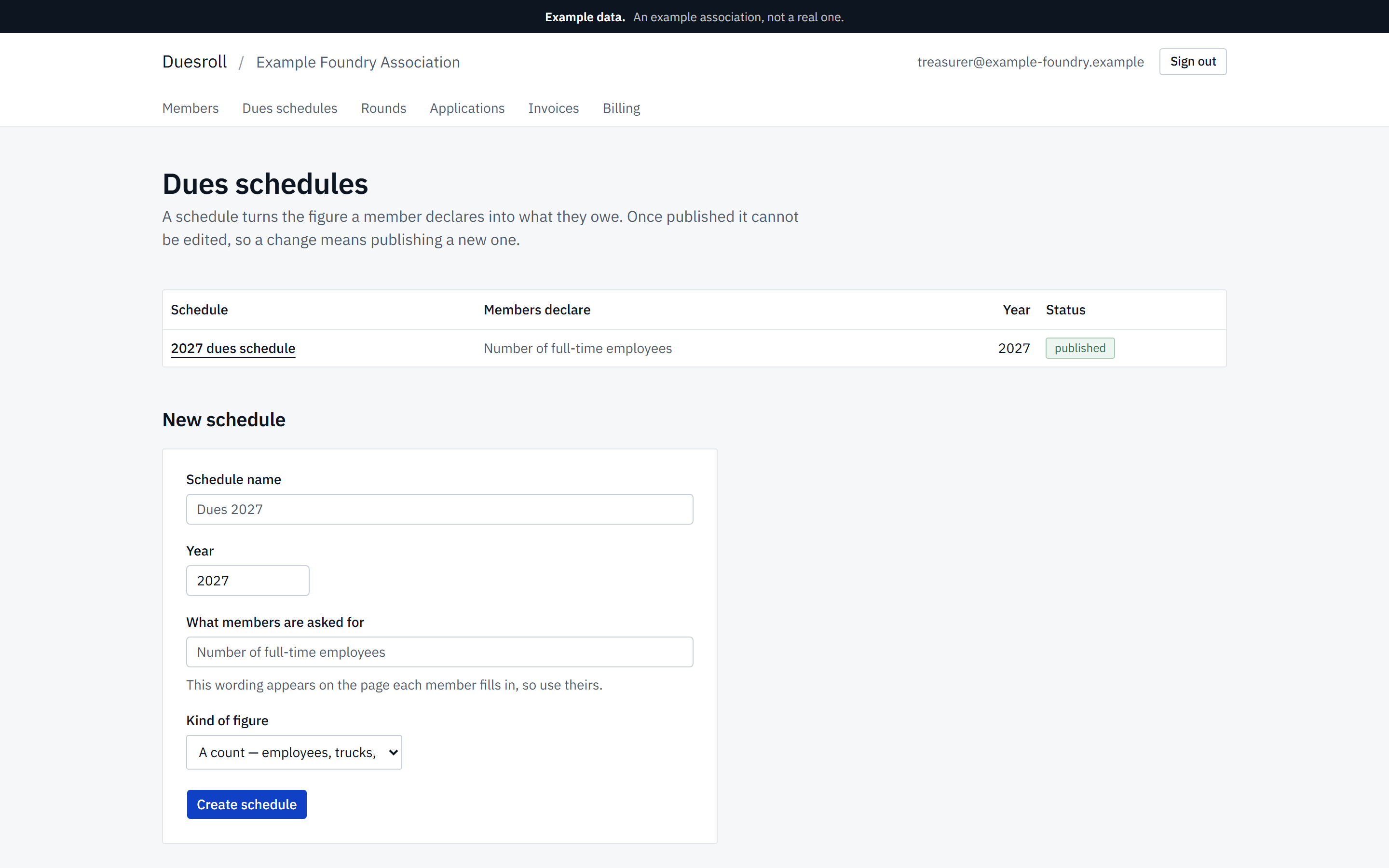
Set your dues schedule once
The list your board approved. 1 to 10 employees pay one amount, 11 to 50 another, and so on, keyed to whatever your dues are based on. Usually four or five rows, typed once. A schedule with a gap or an overlap in it won’t publish, so nobody ever falls between two tiers.
Send one link
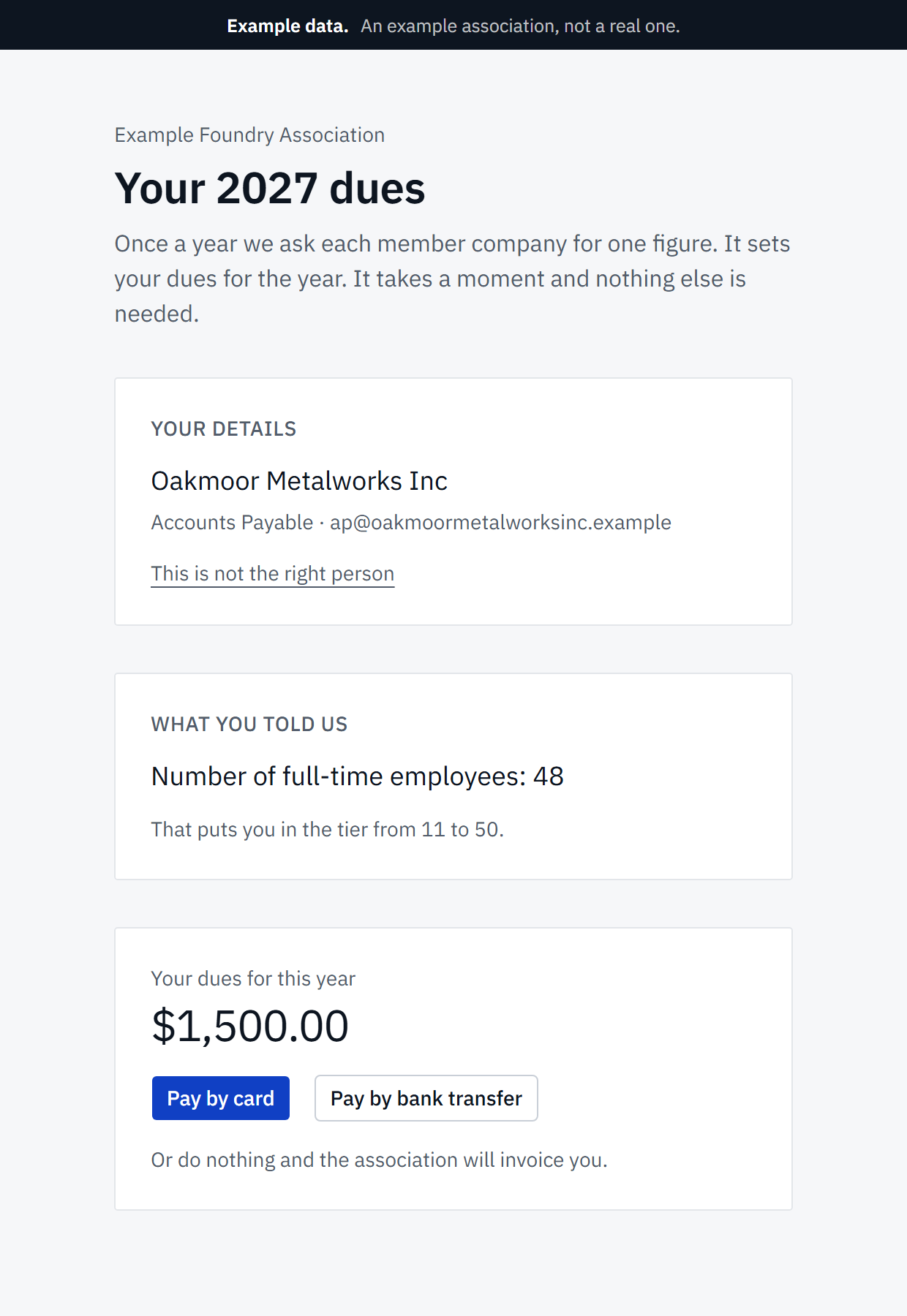
Every member gets a link, confirms who they are, types their number, and sees what they owe. No login, no password, no account to set up, and nothing for you to reset in January.
Collect what comes back
Each member billed at their own tier. Card, bank transfer, PayPal, or checked off when the check shows up. One button chases everyone who hasn’t replied.
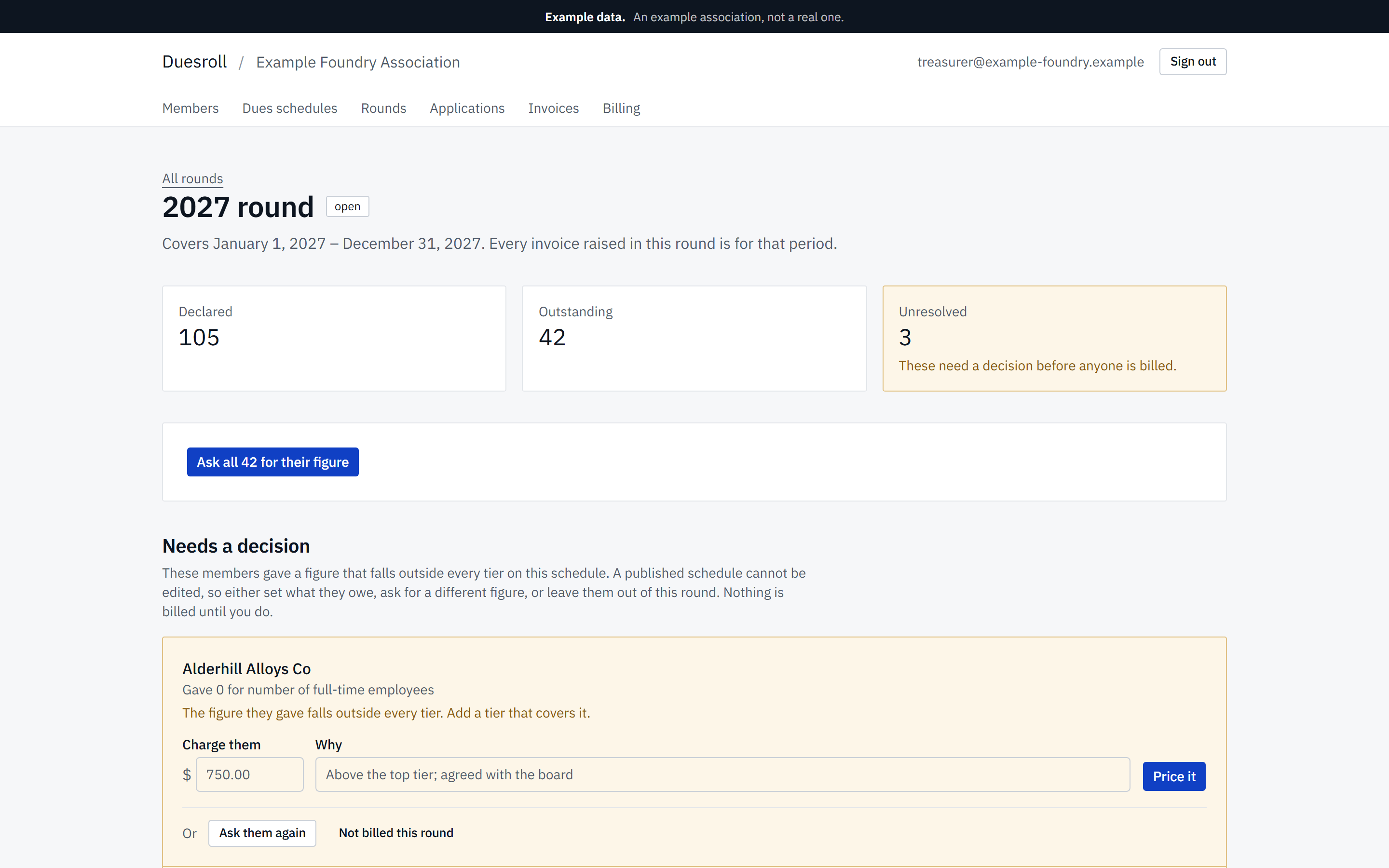
Renewal season, on one screen
A renewal round is one year’s dues, from the first email to the last payment. This one covers 150 member companies and it’s about halfway through. 42 haven’t replied, and one button goes after all of them. 3 gave a figure that fits no tier, so they’re waiting on you instead of getting billed the wrong amount.
Example Foundry Association is an example, not a real association. But it’s a real round in the real software, filled with made-up companies so there’s something honest to photograph, and every figure above is one the product worked out itself.
If your dues depend on member size, most software can’t help you
We checked Wild Apricot, MemberClicks, ClubExpress, Join It, MembershipWorks, Raklet and Haven against their own documentation. In all of them a membership level is just a name and a price. Nothing in it tells the software who it applies to, so the software can’t take a number and figure out the tier. The member has to pick.
What they give you: a membership level for every tier
Each member picks whichever one they think applies. You never see a headcount. And when the board changes the dues, you rebuild every level and move everybody over by hand.
What you get here: one schedule, and a number
The member types 86 and your schedule assigns the tier. Nobody picks their own price, and a figure that fits no tier waits for you instead of getting rounded into the nearest one.
Checked against each product’s own documentation, September 2026. Wild Apricot’s variable dues are a linear multiplier with min/max caps, not brackets or a dues schedule.
If you’re doing this by hand
A spreadsheet holds the dues schedule just fine. Here is everything else a renewal round takes.
That’s the round by hand. Next year you start it again with the spreadsheet and nothing else carried over. Here it’s one link out and one screen back, and next year opens where this one ended.
What it doesn’t do
It doesn’t host your website. You have one already, and the piece of a membership system that’s hardest to ever leave isn’t in here.
It doesn’t run events. If you sell conference tickets or a golf outing, keep using whatever you use now.
It doesn’t send newsletters. Renewal notices, reminders and receipts. That’s the whole list.
What it does is dues. The schedule, the round, the invoices, and your member list brought in from a CSV. Wild Apricot does all that plus everything else, for about $154 a month at your size. If you’ll actually use the rest of it, that’s a fair deal and you should buy theirs.
$49 a month, up to 150 member companies
$99 for any number above that. No setup fee, no annual contract, and no cut of what your members pay.
The spreadsheet is free. This is $588 a year.
That’s the whole comparison. What the $588 buys is the asking, the chasing, the looking up, the invoicing and the reconciling.
Nothing comes out of what a member pays
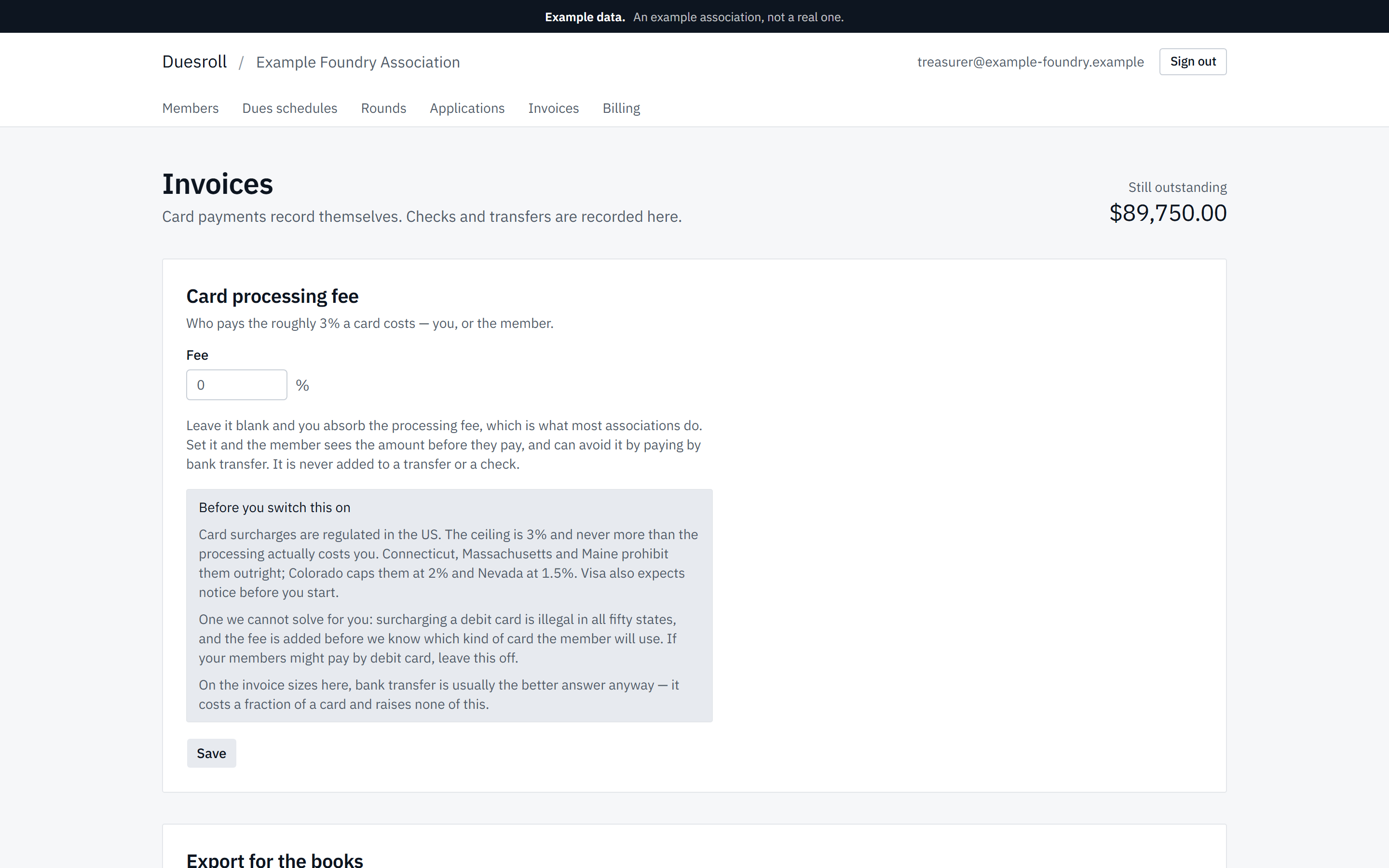
Plenty of membership platforms take a percentage of every payment a member makes, on top of what the card processor charges. Dues here go straight into your own Stripe or PayPal account, so there’s nothing for us to take a cut of.
What each takes out of a member’s payment, on top of card fees. Full pricing, and the arithmetic behind the comparison
We’re opening to the first associations soon
Leave an address and we’ll write when it opens. That’s the only thing we’ll ever use it for.
The first 10 associations pay $25 a month, permanently instead of $49.
For as long as you stay, in exchange for being willing to be named as a customer once you’re live.